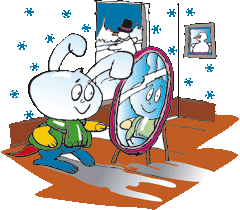
“Snowli, you’ve had a very long journey to get here to Earth. You must understand that snow, too, has a very long and difficult journey before it reaches the ground! Snow isn’t actually just frozen rain. The delicate white snowflakes form inside clouds. Clouds are like a factory that produces tiny crystals, and these are then combined to create snowflakes. When it’s warm, the flakes melt as they fall to Earth and become raindrops. Only in winter, when it’s very cold, do the flakes fall to Earth as snow.”
Snowli could hardly believe that such incredible things happened on Earth and listened attentively to the snowman: “As they fall, the flakes are sometimes carried far away by the wind and pass through moist, cold, and warmer layers of air. These change the flakes, which then take on the most incredible shapes. There are stars, columns, needles, triangles, and squares.” There are thousands and thousands of shapes, and nobody knows if two identical ones have ever fallen to Earth!
"Do you know which is the most beautiful shape?" asked the snowman. "No," replied Snowli, quite bewildered. "The most beautiful shape is definitely the star! That's a snowflake with six points. Next time it snows, let's try to look at one very closely. You'll see, it's so uniform and fragile that you'd think it wasn't from around here!"
"But why do different temperatures change the shape of the flakes?" asked Snowli. "When it's very cold," continued the snowman, "the snow is dry and powdery because the flakes can't stick together. When it's warmer, on the other hand, the snow melts a little and becomes wet. That's why it's much easier to build a snowman with wet snow than with dry snow, because it sticks together much better!"
Snowli, full of curiosity, suddenly asked Mr. Longnose: "How many flakes are you actually made of?" "Oh! Oh! Oh! That's a difficult question, Snowli! So many that it's impossible to count them!" Mr. Longnose replied with a smile.